In the pre-AI era, users “used” applications. They had to adapt their workflows around them. Automations and integrations were few and far between – and typically implemented and maintained by IT or consultants. AI makes all of this effectively irrelevant. Now, users can work the way they want to with their own UX. You can automate complex tasks and workflows with ease. Integrating between disparate systems is effectively no longer a problem. A good API story makes this possible.
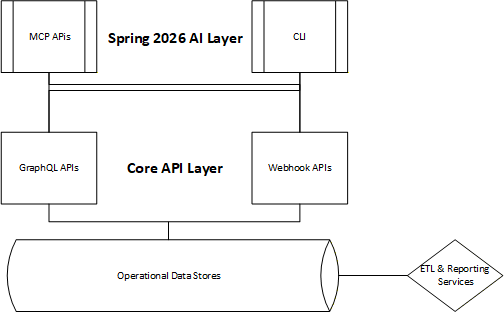
REST and SOAP have historically been the API patterns of choice. These are obsolete. In an AI-first world, one should look at major players such as GitHub or Shopify. They are using a mix of GraphQL and Webhooks. GraphQL enables pulling all data needed in a single query, enabling high efficiency on a per call basis. You also need Webhooks, which enable data to be pushed to subscribed endpoints. The two together can accommodate pretty much any foundation. It is critical to have both to account for both push and pull scenarios in formats that are widely accepted by avant garde players throughout the tech industry.
On top of this, the AI layer can be constructed. Given how rapidly AI standards are evolving, having a stable base enables an organization to easily pivot to the latest and greatest. Today, this is Model Context Protocol, which is the de-facto integration layer for popular LLMs such as ChatGPT or Claude. But, Command Line Interpreters (CLIs) are also becoming extremely popular for working with more development-oriented flavors of the popular LLMs, such as Codex or Claude Code. CLIs are also favored by personal/persistent AI autonomous agents such as OpenClaw or Hermes.
BUT, the future is rapidly evolving and new standards as MCP and CLIs may fall out of favor in lieu of emerging standards such as the Agent-to-Agent (A2A) , Agent Communication Protocol (ACP), Agent-User Interaction Protocol (AG-UI), or something else. The very fact this list is already this long and growing longer makes the case for why a stable base is critical and many more pivots may be needed.
So, the new reference architecture looks something like this for an AI-first SaaS company:
Those that do this will survive and thrive – and become a building block of choice. Those that don’t run the very real risk of being (at least temporarily) usurped by vibe coded solutions and longer term by those that have followed this pattern. Business intelligence and reporting will be equally disrupted, but that’s a topic for another day.
(I had written this post a while back but am in the process of updating my blog infrastructure. But, seeing Ryan Holmes’s post (my former leader – and someone whom I tremendously respect) made me decide to share this now. Enjoy!)
Leave a Reply