Next week, the world will have had generative AI within its repertoire for eleven months, as ChatGPT was first released on November 30th, 2022. Debatably, the world of computing has never seen such a pace of innovation and seemingly gone through the equivalent of a Gartner Hype Cycle in less than a year. My post is not meant to fuel this debate one way or another, but to put it in perspective as to what generative AI means for software developers, or – more broadly – technology-based creators.
My inspiration to write this this post came from one of my favourite AI experts on social media, Paige Bailey (@DynamicWebPaige) who re-posted the following in the last two weeks:

This post struck home. Besides working under @ScottGu during the final stages of my last chapter at Microsoft, I started my Microsoft career as a consulting product (program manager) hired by the IIS / COM+ team working on Windows NT 5.0 and later Windows 2000. In those days, all the core Internet and underlying middleware technologies reported up either through J Allard or as part of the Site Server team. The Internet tidal wave was in the middle of hitting. And the state of Internet software development in the mid/late 1990s is an extraordinary corollary to where the industry now stands with generative AI.
A Refresher on the Internet in the 1990s and Corollary to Today
When the World Wide Web was born, the only way to deliver any interactive functionality was to use what was known as a CGI (Common Gateway Interface) script. CGI scripts were either written in C/C++ or Perl. The barrier to entry was quite high as documentation and examples were quite scarce, at least until resources such as Matt’s Script Archive (which amazingly still exists) came about.
However, the problem with CGI scripts was two-fold. First, they did not scale very well as each execution required a separate process. Second, off-the-shelf scripts were often buggy and insecure; hardcore, high-end developers were required to create secure, performant, and scalable code.
The computing world quickly responded by democratizing interactive Web development. Much easier-to-use frameworks quickly came online, including:
- Active Server Pages from Microsoft
- Cold Fusion from Allaire (later acquired by Macromedia/Adobe)
- Java Server Pages from Sun Microsystems
- WebObjects by NeXT Software (later acquired by Apple)
As these frameworks hit the market, building Websites and Internet applications EXPLODED. Mere mortals could now create interactive Web applications. High-end software developers turned to creating advanced services such as what we rely on today, like Google. By the turn of the century, highly the World Wide Web as we know it today was properly born. The Web went from ~15 million users and 23,500 websites in 1995 to ~360 million users and 17M websites by 2000 and finally ~1 billion users and 65M websites by 2005.
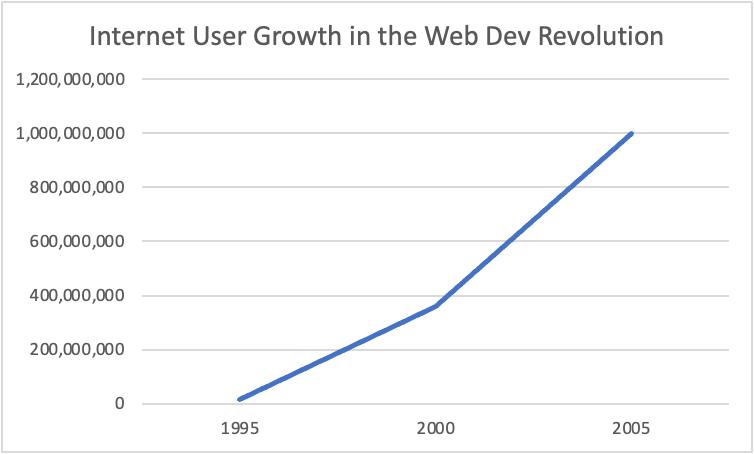
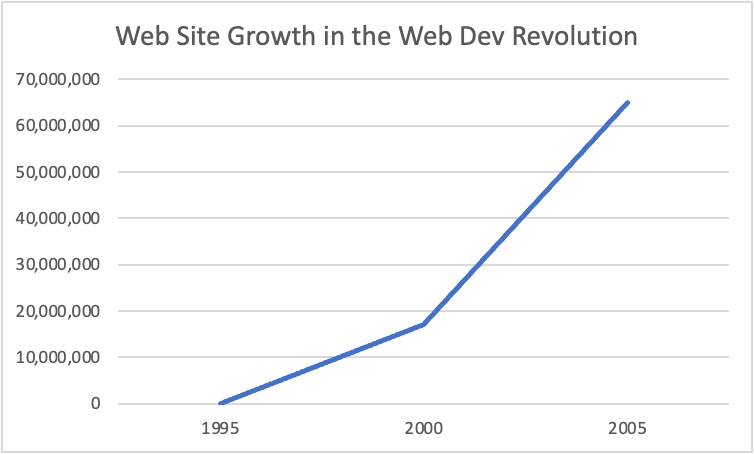
Figures 1 & 2: Internet Growth from 1995-2005
The industry is at an eerily similar moment with generative AI. Creating AI-based applications to-date have required:
- Highly skilled and specialized data science teams
- Very large data sets upon which to build and train machine learning-models
Hence, the barriers to entry have been high. And AI has not been mainstream or high quality outside of specialized use cases (typically delivered by specialized software providers around each use case).
Generative AI and large language models are democratizing the building of AI-enabled applications the same way early Internet frameworks unlocked Web applications; the players now are:
- OpenAI / Microsoft
- Microsoft / GitHub
- Meta
- Amazon / Anthropic
- (and likely soon to be other players)
Now, building AI applications has been democratized the same way building Internet applications was back in the late 1990s. A similar technological revolution is happening, but at far greater scale – now that the Internet has ~5.3 billion active users and ~1.13 billion websites on top of ~5.3 million mobile applications across all major application store platforms, none of which existed in 2005.
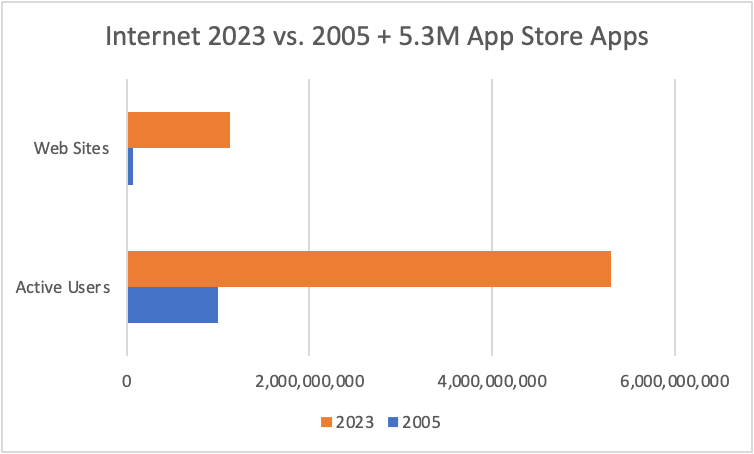
Figure 3 – Internet Growth from 2005-2023; AI growth will be proportionally similar for developers but overall larger given the applicability to content creators
The Calls to Action for Generative AI
For the use cases that generative AI targets and does well (which is a topic for another post…) such as content creation, conversation, and analysis – those that have been building use cases within these realms have unfortunately been usurped. They will be under tremendous pressure to reinvent themselves to creating unique differentiation, most likely at a dramatically lower price point. The barrier to entry for these use cases has just been materially lowered.
Case in point – a few companies ago I was evaluating a conversational support chatbot, with the aim of digitizing a digital knowledgebase to deflect support cases away from human beings. My company at the time did not adopt this chatbot because it was simply too price prohibitive. Now, anyone with a proper set of documentation or knowledge-base articles can create their own conversational help-bot with ChatGPT or equivalent and have an experience that is 80%+ as good on their own at minimal cost.
For the average software developer, having AI-enabled applications will become a table stake. With previously high-barriers to entry now effectively gone, those that do not keep pace will find themselves outpaced by competitors offering such capabilities. A smart call to action for EVERY developer AND product manager is to:
- Learn generative AI
- Walk through every use-case and scenario
- Identify where generative AI can help
- Build a roadmap based on the findings from #3
- Execute quickly
For those already offering AI-enabled applications, the call to action is a bit different:
- Understand how generative AI affects the use cases
- Consider replacing proprietary functionality with off-the-shelf models wherever applicable, potentially retiring significant amounts of proprietary code and its assorted maintenance requirements
- Free up resources and double-down on the proprietary AI use cases and models that truly differentiate one’s business
Generative AI from big-tech will not be everywhere, at once. Significant opportunity exists to innovate and differentiate outside of the mainstream use cases of generative AI and big tech’s large language models.
Lastly, the green-field opportunity is for creators and software developers. Anyone creating content of any kind needs to try generative AI. It can write copy, create images, and even write quite decent code in a multitude of languages. More specialized tools like GitHub CoPilot can take existing code and make it even better. Content can be created at a pace simply unprecedented to even contemplate a year ago. The challenge – however – is going to be output quality. It MUST be checked and SHOULD be refined by a human being. Generative AI will absolutely not replace the jobs of creators and software developers; however those that are not leveraging it will surely be left by the wayside.
EDIT: @DonaSarkar published yesterday what I think is an incredibly useful AI maturity model:

To summarize my thoughts using this model, any creator or individual software developer will need to get to Level 2. Traditional software developers/publishers will need to get to Level 3 or Level 4 in order to have a competitive offering. And, those in the businesses of offering AI solutions, they will need to get to Level 5 in a differentiated area outside of the sights of big tech’s large language models.
Closing and TLDR
EDIT: Microsoft’s earnings beat expectations and their stock is up; AI beat expectations.
In closing, we are in one of the biggest eras of technological innovation in decades (as most lately evidenced by Microsoft’s Q1 FY/Q3 CY business performance). Software development will never be the same and huge opportunities abound. Given the size and scale of the Internet, this era will almost assuredly surpass all previous eras of innovation by several factors of scale. And, for those not in the direct line of sight of the large language models, significant opportunities to build abound. I look forward to seeing what is created next…
Key points recap:
- The era of Generative AI and its democratizing effect on software development will be comparable (albeit at much bigger scale given Internet growth) to the democratization of Web development via mainstream frameworks introduced in the late 1990s.
- This is a huge opportunity (that will be come a table stake) for software developers to offer AI-enhanced applications – including those developing AI outside of the purview of large language models. (Those in the line of sight and competing with large language models will need to find ways to reinvent and differentiate themselves, as the barriers to entry have been reduced to miniscule levels.)
- An even bigger opportunity exists for creators, as generative AI can accelerate the creation of content, images, and code at a pace like nothing seen before. Human review and personalization are still needed. Workforce productivity benchmarks will be reset against those leveraging generative AI, versus those not.
Leave a Reply