Most product organizations have varying degrees of alignment with their various Go-to-Market (GTM) organizations. Best-in-class organizations have a systematic, organized process whereupon:
- Product systematically enables the GTM organization, such that the product value and differentiation is clearly aligned with and baked into all stages of the GTM process beginning with demand generation and flowing all the way through to customer success and support enablement. This would also include unlocking supplemental value and driving upgrades/upsell.
- A clear feedback loop is in place to inform product planning from all stages of the GTM process, right through to when the product is in customers hands
- (optional) A separate process is in place for collaborating with the GTM teams for beta/early access as this, by nature, requires different tactics and far more intimacy between the product team and end customer
Conceptually, it comes together as referenced in the following diagram.
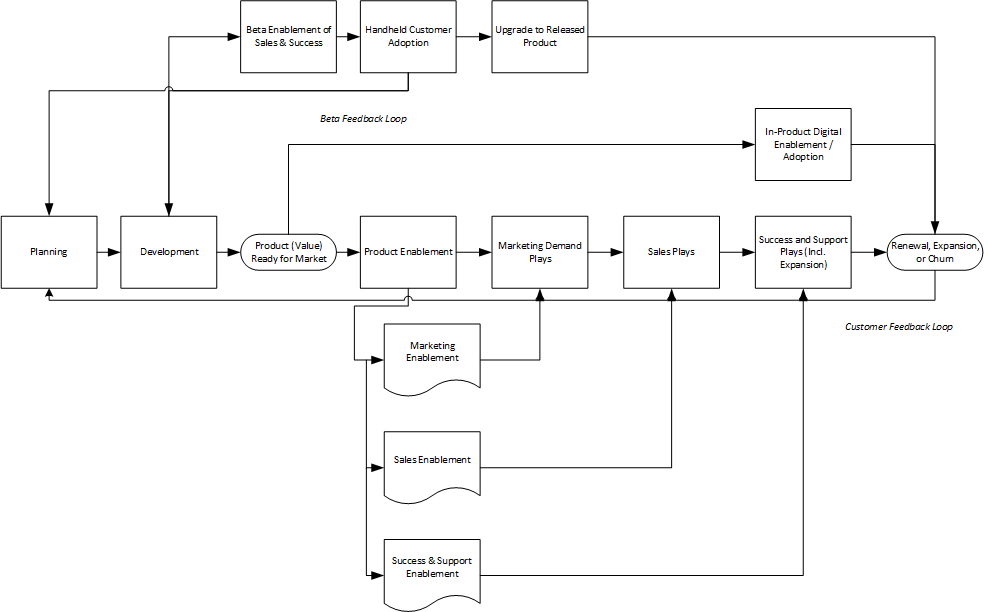
To summarize the journey for shipping/ready-for-market products:
- Product begins with clear personae, use cases, and unique, distinctive value propositions for all of the current product offerings. GTM teams are fully educated and aligned on these as part of a comprehensive and graceful product enablement process. Feedback is iteratively taken and actioned until alignment exists cross-functionality and future needs are fed back for consideration in downstream product cycles.
- Marketing will create and execute Demand Plays based upon the current product offerings to generate demand through whatever channels the organization utilizes to attract the right prospects for the products being delivered to market. Conversely, the demand plays should be working proactively to NOT attract the wrong sorts of prospects, for whom the current product offerings are poor fits. Feedback and learnings are taken for consideration into subsequent iterations.
- Based upon the Marketing Demand plays, Sales will create its Sales Plays to take the prospects and close them as efficiently as possible. Feedback and learnings are taken for consideration into subsequent iterations. As this is the first time product hits customers, this will often identify gaps in offering or value proposition that are causing friction in the sales cycle.
- Next come the Success and Support plays to be delivered by the Customer organization. Here the goals are two-fold. First, the Support organization needs to have the enablement in place to be able to fully support the solution end-to-end, ensuring that users can achieve the expected value. Likewise, the Success team needs the enablement in place and to have the playbooks ready to help the user personae achieve the expected value in the most expeditious manner possible. This is an interesting collaboration opportunity for Product and the Success team, as it is a place where human factors can be utilized to overcome product and usability shortcomings on the path to realizing value (hopefully on a very temporary basis).
- Here is also where Upsells and Upgrades happen. As part of the path to helping end-users realize value, the Success plays should encapsulate helping users graduate to the next tiers of the product, thereby triggering an increase in net dollar expansion.
- Lastly, this entire journey – as it is where the product touches customers hands – should be a rich source of feedback from both those on the Success team as well as end customers themselves to learn and inform subsequent product iterations.
For those wishing to deliver pre-release products to market for early user validation (a best practice that is highly recommended), an abbreviated version of this process can be followed whereupon Product:
- Enables Sales to the extent possible to identify and close an early adopter customer
- Enables Success and Support on how to deliver the incremental value in the new release
- Product works with both the GTM teams and the customer directly to handhold them through the adoption process to capture feedback and learnings to make adjustments before the product is delivered to market
And for those companies that have Product Led Growth (PLG)-components, the best practice is don’t split responsibilities. It should live with product versus being split, unless the company is of a small enough size that it is impossible to do so due to headcount constraints.
Leave a Reply